
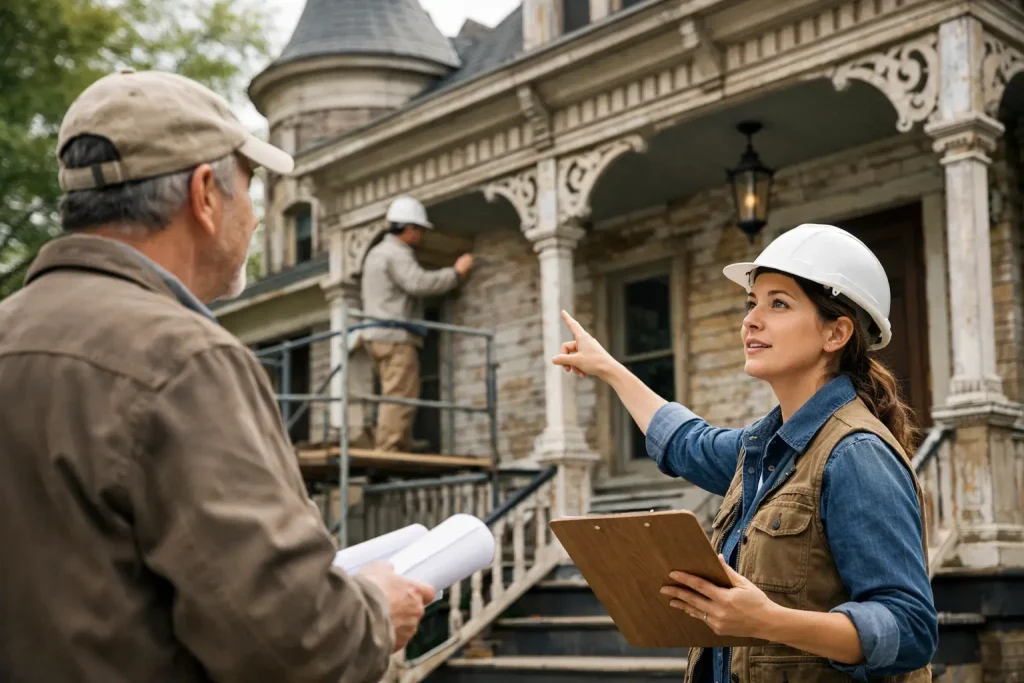
A London period house can appear settled and complete while concealing decades of compromised repairs, altered structure and failing services. The role of heritage home restoration specialists is not simply to make an older property look beautiful again. It is to understand what is original, what has been changed, what must be protected and where thoughtful intervention will make the home work properly for modern life.
For owners of listed buildings and homes in conservation areas, that judgement has real consequences. It influences planning strategy, programme, cost, building performance and the lasting value of the property. A sensitive restoration needs design awareness, technical expertise and disciplined delivery in equal measure.
Why heritage homes need a different approach
Older houses were built using materials and methods that behave differently from contemporary construction. Solid brick walls, lime mortar, timber joists, traditional sash windows and natural slate roofs all need to be assessed as parts of a connected building fabric. Applying a modern solution without considering moisture movement, ventilation or structural load can create problems that are more expensive to resolve later.
A common example is damp. The visible symptom may be peeling paint or a musty room, but the cause could be defective rainwater goods, inappropriate cement pointing, bridged external ground levels or poor ventilation. Treating only the surface is rarely a restoration. It can trap moisture within the wall and accelerate decay.
The same principle applies to structural alterations. Removing a wall, opening a lower-ground floor or extending a rear elevation may be entirely possible, but it requires a clear understanding of the existing structure before work begins. In period properties, assumptions are costly. Detailed investigation allows the project team to design interventions that preserve character while providing the strength, comfort and functionality the household expects.
What heritage home restoration specialists assess first
The best decisions are made before the site is opened up. An early survey should establish the property’s condition, significance and constraints, rather than relying solely on estate-agent plans or a visual inspection.
This process often includes close inspection of roofs, chimneys, joinery, masonry, plasterwork and drainage, alongside an assessment of previous alterations. Where necessary, selective opening-up works can confirm how floors, walls and services have been formed. This is particularly valuable in London townhouses, where successive refurbishments may have concealed redundant pipework, unsupported alterations or uneven floor structures.
Significance matters as much as condition. A decorative cornice, original staircase, historic fireplace or surviving timber panelling may be central to the building’s character. Elsewhere, later additions may have little heritage value and can be reconsidered. Distinguishing between the two provides a sound basis for the design and for any listed building consent application.
A clear record of existing conditions also supports more honest budgeting. Heritage work contains variables, and not every issue can be known at the outset. However, careful investigation reduces avoidable surprises and enables sensible allowances where uncertainty remains.
Balancing conservation with modern living
Restoration should not require a family to live as though the house were a museum. The strongest projects retain the qualities that make a period home special while quietly improving how it performs day to day.
This might mean reconfiguring a cramped lower ground floor into a useful kitchen and family space, introducing discreet underfloor heating, upgrading electrical capacity or improving acoustic separation between rooms. It may involve restoring original windows where practical, then improving draught resistance and secondary glazing rather than replacing historic joinery with an unsuitable alternative.
There is no single rule for energy efficiency in an older home. Internal wall insulation can improve comfort, for example, but it changes the way a solid wall manages moisture and may affect original details. A carefully specified system, appropriate ventilation and exacting installation are essential. In some properties, targeted improvements to the roof, floor, windows and heating controls offer a better balance between performance, fabric protection and cost.
The aim is measured intervention. New work should be technically sound, visually considered and proportionate to the building. Where contemporary elements are introduced, they should sit confidently alongside the original architecture rather than imitate it poorly.
Consent, coordination and control
Listed building consent, planning permission and building regulations are separate processes with different purposes. Whether approval is required depends on the building, the scope of work and the detail of the proposals. Even apparently modest changes, such as altering historic joinery or removing internal fabric, can require consent in a listed property.
This is why early coordination between the homeowner, designer, heritage consultant, structural engineer and contractor matters. A proposal that is elegant on paper must also be buildable, approvable and capable of being delivered without unnecessary disruption. Bringing construction expertise into the conversation early helps identify practical implications before drawings are fixed.
During delivery, control comes from clear sequencing and communication. Restoration often involves specialist trades working around one another: roofers protecting the building envelope, carpenters repairing joinery, plasterers using compatible materials, and mechanical and electrical teams fitting services without damaging significant fabric. These activities need close management, particularly in occupied homes or constrained London streets where access and storage are limited.
A well-run site does not eliminate every discovery. It provides a calm process for addressing discoveries properly, documenting options and agreeing the right response before work proceeds.
Craftsmanship is visible in the details
The quality of a heritage restoration is often judged in the smallest moments. It is in the profile of a repaired moulding, the fine sightlines of a sash window, the neat junction between old and new timber, and the way a new service route avoids unnecessary damage to historic plaster.
These details cannot be treated as decoration added at the end of a project. They require early thought, samples, mock-ups where appropriate and tradespeople who understand traditional materials. Lime plaster, stone repairs, timber splicing and joinery conservation each demand a different level of care from standard refurbishment work.
Equally, premium craftsmanship should not mean preserving every imperfection without question. Some later repairs may be unsuitable, unsafe or visually intrusive. The task is to make informed choices: retain and repair where value exists; replace like for like where repair is no longer viable; and introduce new elements where they improve the home without diminishing its character.
Choosing the right restoration partner
A heritage project is easier to manage when responsibility is clear. Homeowners should look for a team that can explain the condition of the property in plain language, coordinate the required consultants and maintain visibility over programme, cost and decisions on site.
Relevant experience matters, but so does the working process. Ask how unforeseen conditions are handled, who will manage day-to-day communication, how finishes are reviewed and how the contractor protects existing features throughout the works. A detailed scope, realistic programme and transparent change-control process offer far greater reassurance than a low initial estimate with limited definition.
For major refurbishments, extensions and listed building restorations, an integrated delivery team can reduce the friction between design intent and construction reality. Alchemy Build approaches these projects with the technical rigour required for sensitive fabric and the meticulous craftsmanship expected of a high-end London home.
A restoration that earns its future
The most successful heritage projects do not freeze a building in time. They give it another useful, beautiful chapter. Original materials are protected where they matter, modern interventions are carefully resolved, and the home becomes more comfortable and dependable for the people living in it.
Start with a thorough understanding of the building, allow enough time for informed design and approvals, and choose specialists who treat every intervention as part of the property’s longer story. That is how a period home retains its character while becoming genuinely ready for the years ahead.